AI

— London
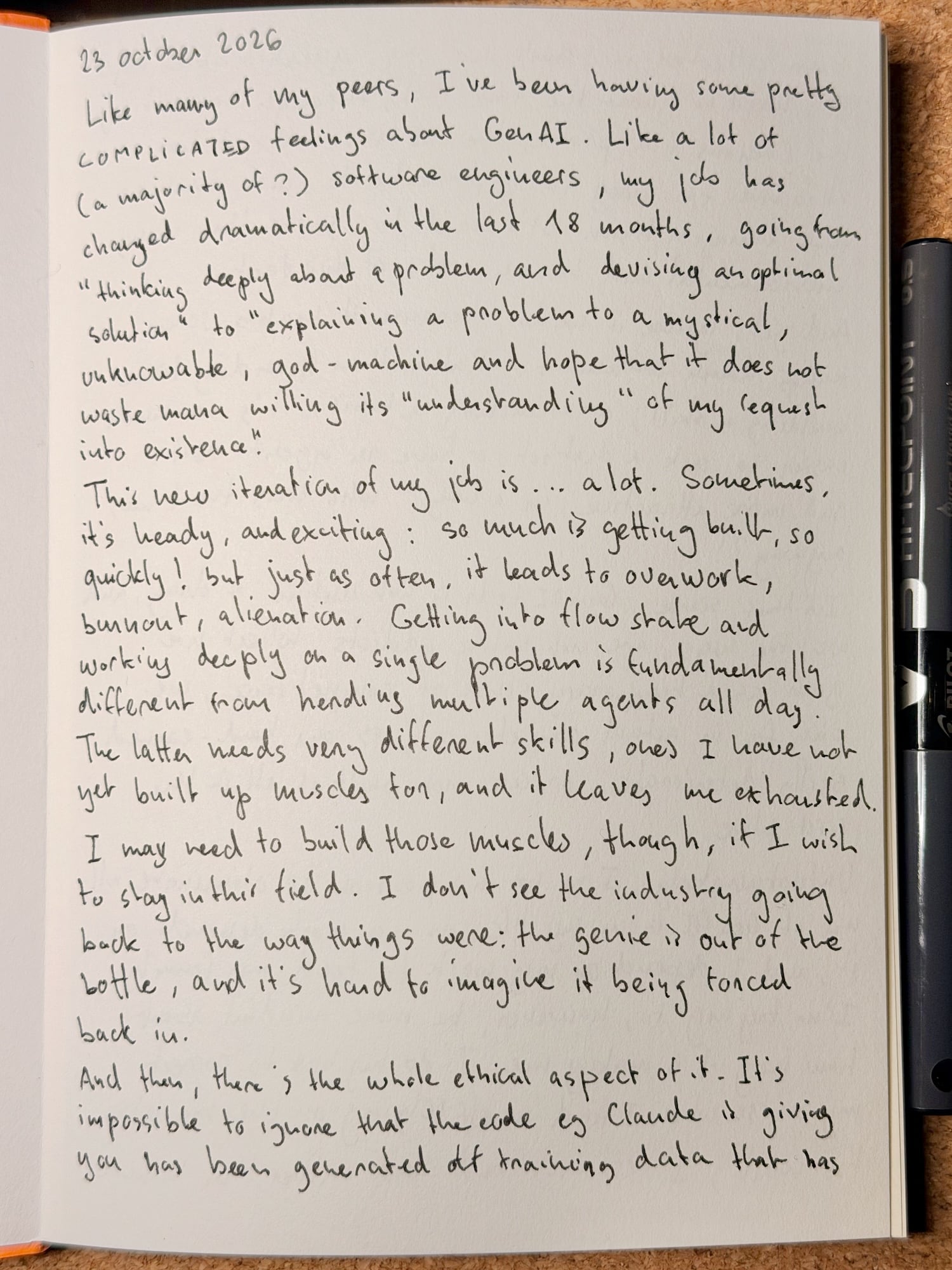
23 October 2026: Like many of my peers, I've been having some pretty COMPLICATED feelings about GenAI. Like a lot of (a majority of?) software engineers, my job has changed dramatically in the last 18 months, going from “thinking deeply about a problem, and devising an optimal solution” to “explaining a problem to a mystical, unknowable, god-machine and hope that it does not waste mana willing its ‘understanding’ of my request into existence”. This new iteration of my job is… a lot. Sometimes, it's heady, and exciting: so much is getting built, so quickly! But just as often, it leads to overwork, burnout, alienation. Getting into flow state and working deeply on a single problem is fundamentally different from herding multiple agents all day. The latter needs very different skills, ones I have not yet built up muscles for, and it leaves me exhausted. I may need to build those muscles, though, if I wish to stay in this field. I don't see the industry going back to the way things were: the genie is out of the bottle, and it's hard to imagine it being forced back in. And then, there's the whole ethical aspect of it. It's impossible to ignore that the code eg Claude is giving you has been generated off training data that has…
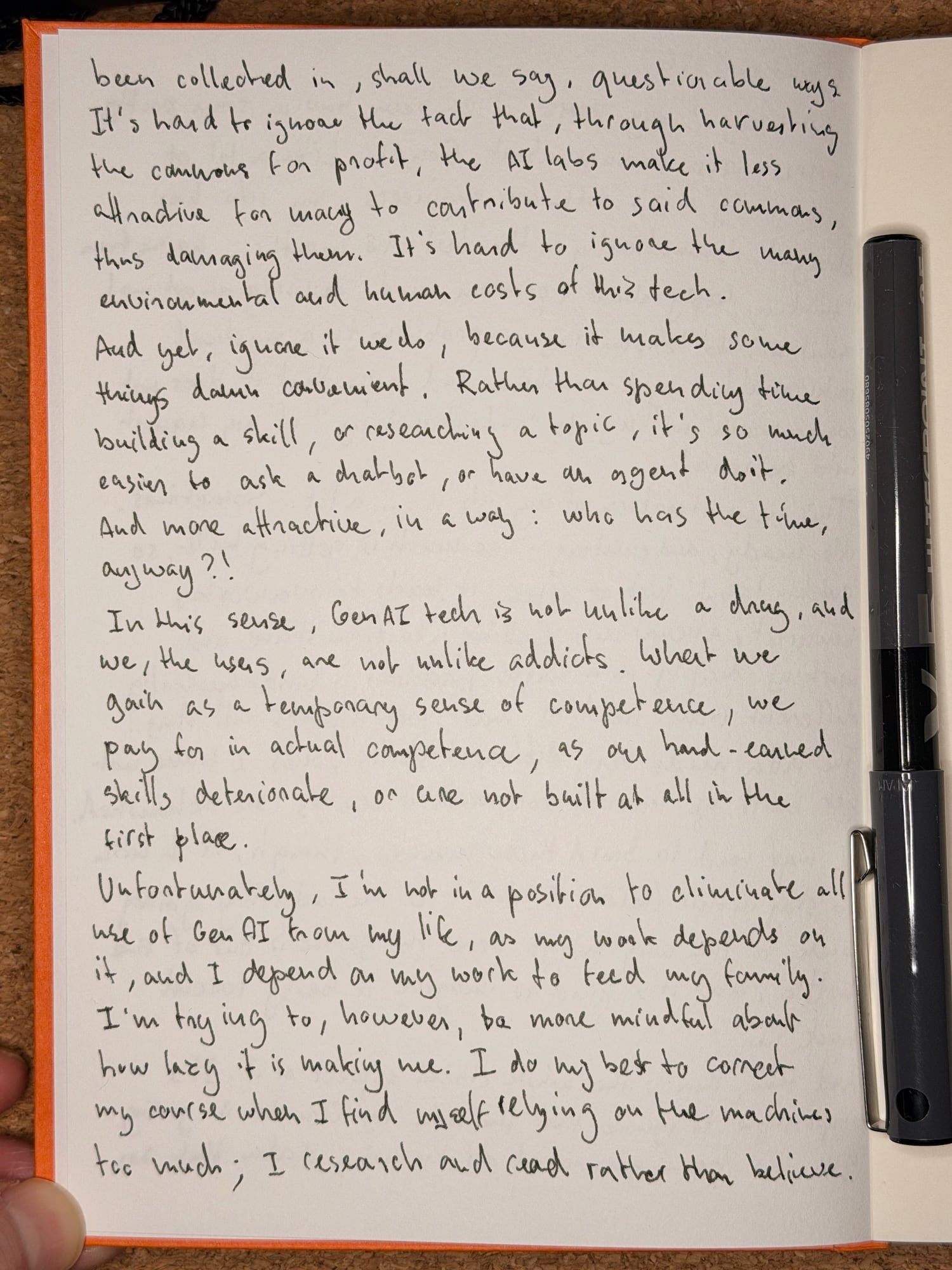
…been collected in, shall we say, questionable ways. It's hard to ignore the fact that, through harvesting the commons for profit, the AI labs make it less attractive for many to contribute to said commons, thus damaging them. It's hard to ignore the many environmental and human costs of this tech. And yet, ignore it we do, because it makes some things damn convenient. Rather than spending time building a skill, or researching a topic, it's so much easier to ask a chatbot, or have an agent do it. And more attractive, in a way: who has the time, anyway?! In this sense, GenAI tech is not unlike a drug, and we, the users, are not unlike addicts. What we gain as a temporary sense of competence, we pay for in actual competence, as our hard-earned skills deteriorate, or are not built at all in the first place. Unfortunately, I'm not in a position to eliminate all use of GenAI from my life, as my work depends on it, and I depend on my work to feed my family. I'm trying to, however, be more mindful about how lazy it is making me. I do my best to correct my course when I find myself relying on the machines too much; I research and read rather than believe.

Forgot to mention that the book The Nerd Reich, by Gil Durán, is a great (if depressing) read if you’re curious about the politics behind the big American AI labs.

(Thanks to Derek Wessmann for the idea of hand-written posts!)